The Purpose of Risk Assessment in BCM
Risk assessment answers a simple but crucial question: "What could happen to disrupt our critical business processes, with what probability and what impact?"
Unlike a Business Impact Analysis (BIA), which focuses on the consequences of an outage (the "what" happens if it stops?), risk assessment focuses on the causes (the "why" might it stop?).
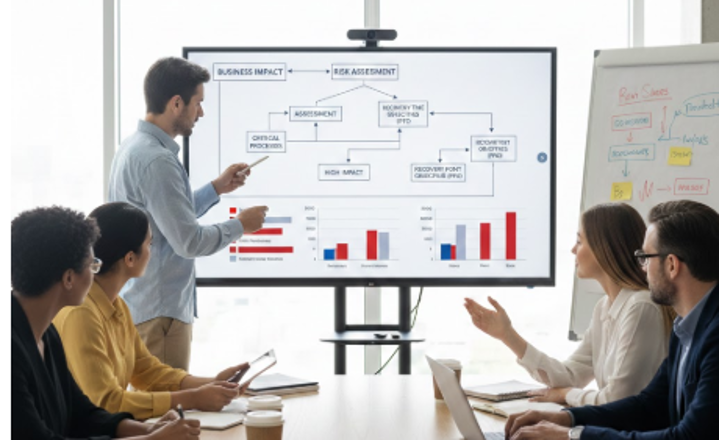
The two processes are complementary and form the foundation of BCM:
- The BIA identifies what needs to be protected (critical processes) and to what extent (RTO, RPO),
- Risk Assessment identifies what we need to protect ourselves against (the threats).
Identification des menaces (Risk Identification) :
How? Through brainstorming sessions, interviews, scenario analyses, and feedback.
What? We list every potential event that could affect business continuity.
Examples of threats: Cyberattacks (ransomware), fire, flooding, power outages, network outages, loss of a critical supplier, pandemics, strikes, sudden resignations of key personnel, etc.
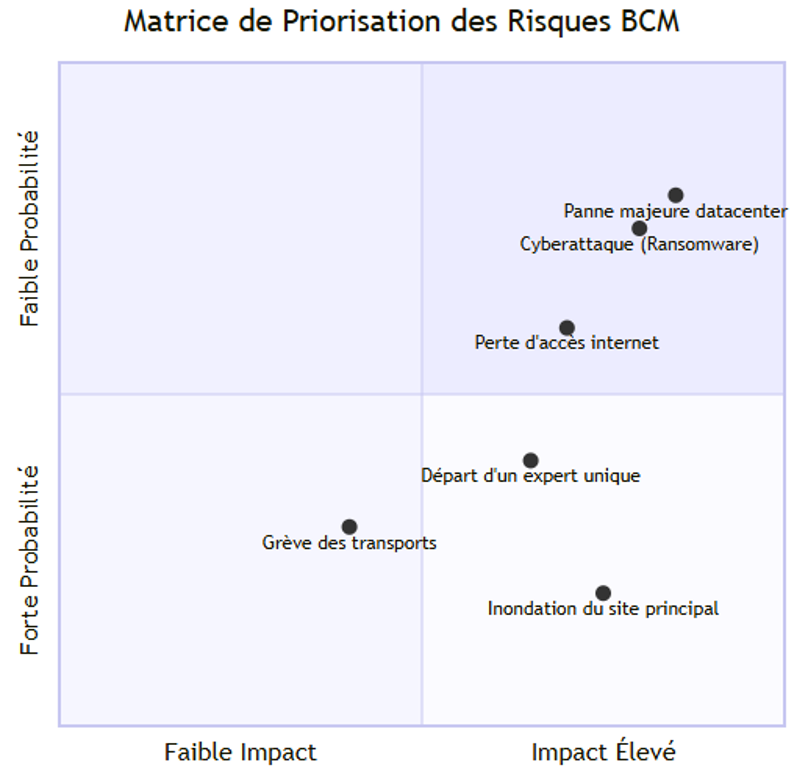
Risk Analysis
For each identified threat, we assess:
- The probability of it occurring.
- Its potential impact on critical processes (using data from the BIA).
We also identify vulnerabilities that increase the risk (e.g., "no up-to-date firewall" is a vulnerability that increases the likelihood of a cyberattack).
The Purpose of Risk Assessment in BCM
Assessment and Prioritization (Risk Assessment):
- The risk matrix is used to classify each risk (e.g., Acceptable, To Be Monitored, Unacceptable).
- The goal is to answer the question: "Which risks require immediate action, and which risks can we accept or transfer (through insurance)?"
The Purpose of Risk Assessment --> Take Action
Definition of Risk Treatment Strategies:
This is the action phase. For each priority risk, a strategy is defined:
- Mitigation: Implement proactive measures to reduce the likelihood or impact (e.g., install backup generators to reduce the impact of a power outage).
- Acceptance: Accept the risk because its impact or probability is too low to justify an investment.
- Transfer: Purchase insurance to protect yourself financially.
- Elimination: Stop the activity that poses the risk (often unrealistic for core business operations).
The connection to the BCM plan: Business continuity plans (BCPs) and disaster recovery plans (DRPs) are themselves mitigation strategies for risks that cannot be avoided. They aim to reduce the operational impact of an incident when it occurs.
Overview - What BCM@LGX Offers

POPA
POPA is a structured inventory and mapping process designed to identify all of the organization's processes and activities, their owners, and their first-level dependencies.
The objective is to establish a comprehensive framework for the scope of operations, which will serve as an essential foundation for conducting Activity Impact Assessments (AIA).
BCM@LGX guides you through the process of drafting each POPA: you describe the process, its critical activities, and the tolerable downtime.
Business Impact Analysis
BIA is a structured process designed to identify the organization's critical activities, the resources needed to carry them out, and to determine the potential impacts of a disruption.
The goal is to define the business continuity requirements (recovery time objectives) that will serve as the basis for developing the business continuity strategy and plans.
BCM@LGX guides you through the process of drafting each BIA: based on the VPAP’s activities, you note the impact of an outage over time, and the tool calculates the acceptable downtime and maximum data loss.
MVC
The MVC is a comprehensive, structured overview designed to map all of the technical, application, and infrastructure components that support the organization's activities.
The goal is to formalize the chain of technological dependencies in order to accurately assess the impact of an infrastructure failure on the operation of business processes.
BCM@LGX automatically generates the MVC: based on the BIAs, it compiles a list of critical activities and applications along with their most urgent deadlines, and identifies the core elements without which the organization cannot function.
Using the MVC framework, BCM@LGX develops the Recovery Sequence: by analyzing the relationships between applications and their recovery times, it proposes the order in which systems should be brought back online at the enterprise level.
Resilience—Defining Business Continuity Strategies (BCP)
The goal is to determine how to keep critical operations running during an incident, without necessarily having to restore them from a backup.
For each critical process in your MVC:
- Remote Work Solutions: Can teams work from another location or from home? (Requires a VPN and secure access to applications.)
- Technical Resilience Solutions: Should We Implement High Availability?
- Mutual agreements or contracts with other sites: Can you relocate your teams to another company site?
- Manual/Contingency Plans: For highly manual processes, what alternative procedure should be implemented (e.g., temporary use of paper forms)?
BCM@LGX helps you draft the deliverable: The application guides you through the drafting of each Business Continuity Plan (BCP)—based on the Business Impact Analysis (BIA), you describe dependencies, scenarios, and fallback modes, and the application drafts the process continuity plan.
Defining Disaster Recovery Strategies (DRP)
Here, we focus on restoring the IT infrastructure and applications that support critical processes following a serious incident (e.g., loss of the data center).
For each application/server:
- Backup Technology: Does the current solution (e.g., tape backup) meet the RTO? If not, should we switch to faster solutions (VM replication, disk snapshots)?
- Disaster Recovery Site: Where will you restore your servers?
- Cold/warm/hot site? Your (MVC) strategy and your RTOs will determine the choice. A 4-hour RTO requires a "warm" or "hot" site, not a "cold" site that takes 2 days to activate.
- Restoration Order: Define the exact sequence in which servers should be restarted (e.g., first the Active Directory domain, then the database, then the application). This is critical for meeting the RTO.
BCM@LGX helps you draft the deliverable: The application guides the drafting of each Business Continuity Plan (BCP)—based on the application profile, its dependencies, and its recovery timelines, it drafts the scenarios and procedures for restoring the system to operation.
Resilience of Critical Services - Tier 0
Tier 0 is a structured assessment of the core technical services on which the rest of the information system depends: time synchronization, name resolution, address allocation, directory services, storage, certificates, and virtualization.
The goal is to establish a reference framework for these foundations and their resilience measures. Without them, no activity or application can resume. This analysis lays the groundwork for technical recovery.
BCM@LGX guides you through the assessment of each Tier 0 service: you describe the current state and the resilience measures already in place.
Mitigation
Mitigation is the structured process that transforms identified gaps in Tier 0 services and applications into concrete actions: design, implementation, verification, maintenance, roles, and scheduling.
The goal is to address these gaps before an incident occurs, so that the technical infrastructure and critical applications can remain operational or be restored within the established timeframes.
BCM@LGX guides you through the process of drafting each mitigation plan: based on analyses already conducted, it proposes measures, and you specify the implementation, responsibilities, and milestones.
BCMS Management
Business Continuity Management System (BCMS) governance refers to the structured monitoring of the business continuity management system. It encompasses key performance indicators, the results of drills, open actions, audits, management reviews, and the resilience of critical suppliers.
The goal is to provide management with an up-to-date overview of the system and to ensure that every deviation—whether it involves an exercise, an incident, a change, or an audit—is addressed through follow-up actions until it is resolved.
BCM@LGX guides you through this process: you can view metrics, record reviews and audits, and address any open actions.